
02/25/2026 Update: In response to our ongoing requests for a complete administrative record, the government produced two supplements to the administrative record in December 2025 and January 2026. New documents from these supplements have been included below. Even after these supplements, the administrative record remains woefully incomplete. FarmSTAND filed motions in court to require the government to produce a complete record, as required by law, and for sanctions due to its prolonged failure to do so.
07/09/26 Update: In late May of 2025, the court granted our motion to supplement the administrative record. The court ordered USDA to begin rolling productions of documents to complete the record by September 2, 2026. The court also ordered defendants to respond to requests for information, called interrogatories, and additional requests for documents. While USDA almost immediately started missing their agreed-upon deadlines, they have begun supplementing the administrative record. Key new documents have been added to the Deep Dive below.
The United States Department of Agriculture was established in 1862 by President Abraham Lincoln, who called it “The People’s Department.” USDA is supposed to support America’s farmers and build a resilient food system, including through the grants it awards to farmer and nonprofit groups. In 2025, USDA abandoned farmers by recklessly terminating millions of dollars in grants, all to fall in line with the Trump administration’s crusade against DEI, environmental justice, and climate action.
These cuts have thrown the livelihoods of farmers across the country into turmoil. Without these funds, farmers have lost access to markets to sell their goods, educational programs for new farmers have been cancelled, and fields have gone unplanted and unharvested. In short, much of the progress we’ve made towards a fair food system has been undermined and undone by the USDA’s actions.
Before their grants were suddenly ripped away, the farmer organizations impacted went through a robust application and approval process to win these grants in the first place, spending hundreds of hours and hundreds of pages justifying their grants to the government.
When we sued USDA and DOGE over these grant cancellations alongside Earthjustice and Farmers Justice Center, we had good reason to believe that the government hadn’t spent nearly as much time deciding which grants to cancel and instead hastily and unlawfully terminated hundreds of grants without individualized consideration. One big clue was that the cancellation notices were clearly from a template used en masse. Some even had the file name “Full Termination Letter Template.”
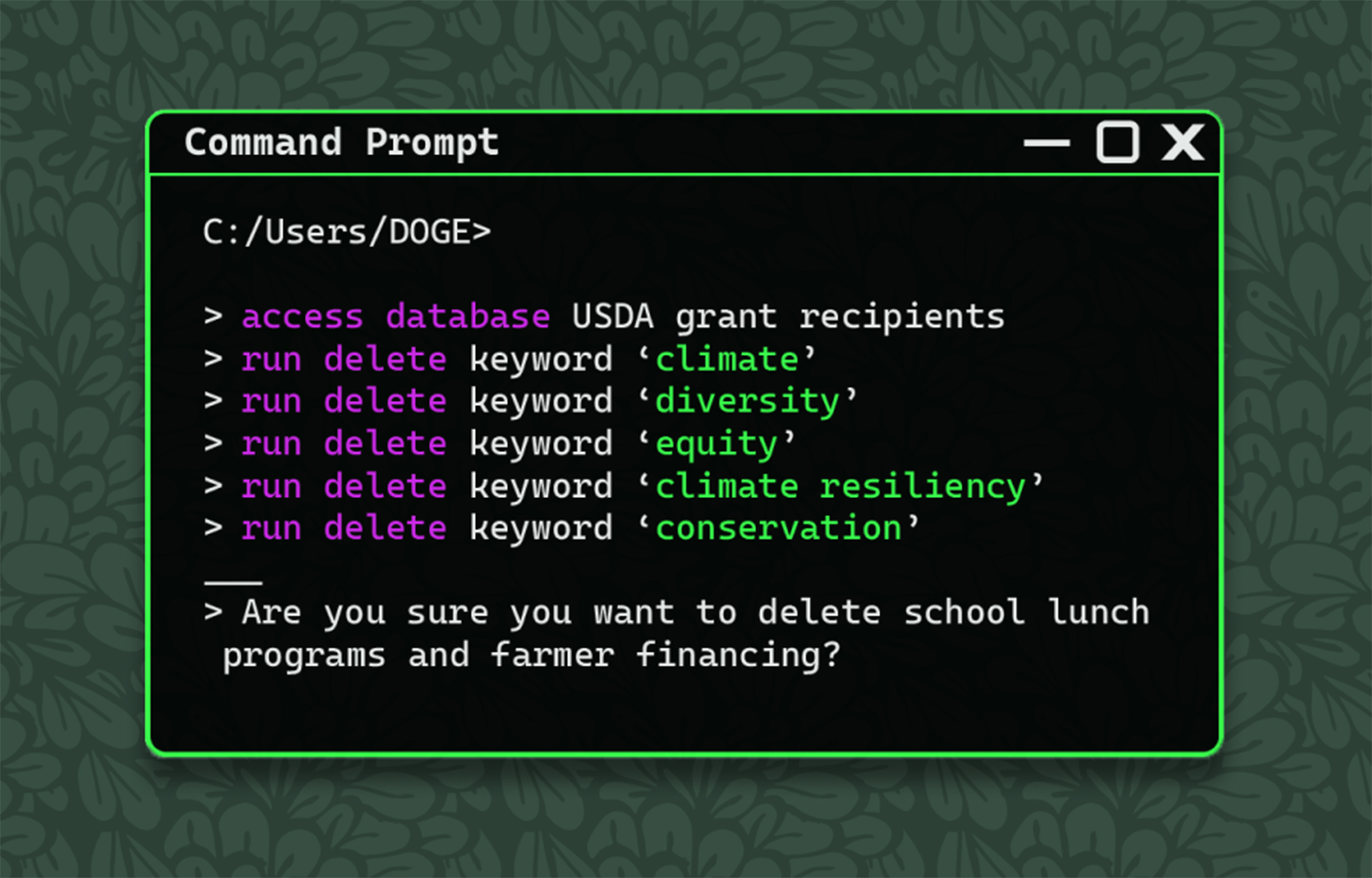
We suspected that the “process” for finding grants the administration found worthy of termination was hardly more than a simple search through grant documents for words it associated with diversity, equity, inclusion, or climate change. Now we can prove it.
We won preliminary relief to the tune of $34 million for our plaintiffs whose grants were cancelled, but we’re still arguing in court that the broader policy that resulted in over 600 grant terminations is unlawful. Through the suit, we are forcing the government to show its work — whether it went about these cancellations lawfully, or, as we believe, with callous, corner-cutting methods to achieve the administration’s political ends: boosting Big Ag and shutting down progress towards a fair food system.
The government has now produced the administrative record in this case. An administrative record is supposed to be the complete collection of documents that the government considered when making a decision — in this case the decision to terminate these grants. While the government has so far failed to give us a complete administrative record in this case, what the government has given us thus far reveals just how careless and unlawful these terminations were.