Saltir al contenido
Puesto de granja
    • Justicia laboralAbogar por condiciones seguras, salarios justos y dignidad para los agricultores y trabajadores
    • Agricultores y Comunidades RuralesFortalecimiento de los sistemas alimentarios locales a través de mercados justos y equitativos
    • Clima y protección ambientalTrabajando para detener el lavado de imagen verde engañoso y hacer cumplir las leyes ambientales
    • Bienestar AnimalLucha contra las leyes Ag-Gag que sofocan las protestas contra la cría intensiva de animales inhumana
    • Derechos del consumidorDefendiendo el derecho a un etiquetado claro y a la transparencia sobre las prácticas de producción de alimentos
  • Casos judiciales
    • Todos los casos judiciales
  • Involúcrate
  • Noticias
    • En las noticias
    • Perspectivas
    • Análisis profundos
    • Comunicados de prensa
    • Para los medios
  • Acerca de
    • Nuestro Equipo
    • Junta Directiva
    • Empleos en FarmSTAND
  • Dona
  • Regístrate
  • Contacto
Buscar
November 13, 2025

Deep Dive: Trump’s Ten Search Terms to Cancel American Farmers

Inmersión profunda

Agricultores y Comunidades Rurales

02/25/2026 Update: In response to our ongoing requests for a complete administrative record, the government produced two supplements to the administrative record in December 2025 and January 2026. New documents from these supplements have been included below. Even after these supplements, the administrative record remains woefully incomplete. FarmSTAND filed motions in court to require the government to produce a complete record, as required by law, and for sanctions due to its prolonged failure to do so.

07/09/26 Update: In late May of 2025, the court granted our motion to supplement the administrative record. The court ordered USDA to begin rolling productions of documents to complete the record by September 2, 2026. The court also ordered defendants to respond to requests for information, called interrogatories, and additional requests for documents. While USDA almost immediately started missing their agreed-upon deadlines, they have begun supplementing the administrative record. Key new documents have been added to the Deep Dive below.


The United States Department of Agriculture was established in 1862 by President Abraham Lincoln, who called it “The People’s Department.” USDA is supposed to support America’s farmers and build a resilient food system, including through the grants it awards to farmer and nonprofit groups. In 2025, USDA abandoned farmers by recklessly terminating millions of dollars in grants, all to fall in line with the Trump administration’s crusade against DEI, environmental justice, and climate action.

These cuts have thrown the livelihoods of farmers across the country into turmoil. Without these funds, farmers have lost access to markets to sell their goods, educational programs for new farmers have been cancelled, and fields have gone unplanted and unharvested. In short, much of the progress we’ve made towards a fair food system has been undermined and undone by the USDA’s actions.

Before their grants were suddenly ripped away, the farmer organizations impacted went through a robust application and approval process to win these grants in the first place, spending hundreds of hours and hundreds of pages justifying their grants to the government.

When we sued USDA and DOGE over these grant cancellations alongside Earthjustice and Farmers Justice Center, we had good reason to believe that the government hadn’t spent nearly as much time deciding which grants to cancel and instead hastily and unlawfully terminated hundreds of grants without individualized consideration. One big clue was that the cancellation notices were clearly from a template used en masse. Some even had the file name “Full Termination Letter Template.”

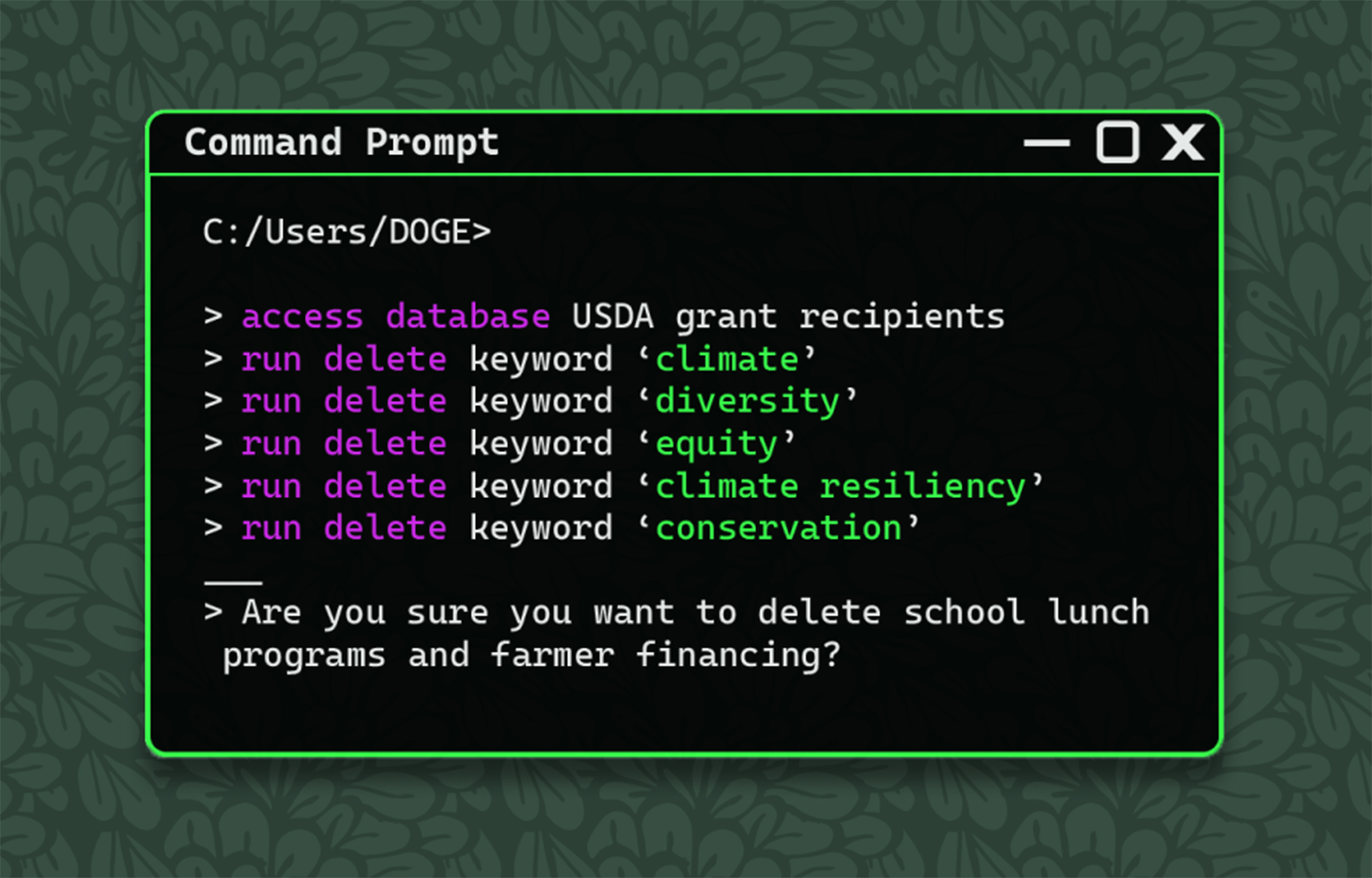
We suspected that the “process” for finding grants the administration found worthy of termination was hardly more than a simple search through grant documents for words it associated with diversity, equity, inclusion, or climate change. Now we can prove it.

We won preliminary relief to the tune of $34 million for our plaintiffs whose grants were cancelled, but we’re still arguing in court that the broader policy that resulted in over 600 grant terminations is unlawful. Through the suit, we are forcing the government to show its work — whether it went about these cancellations lawfully, or, as we believe, with callous, corner-cutting methods to achieve the administration’s political ends: boosting Big Ag and shutting down progress towards a fair food system.

The government has now produced the administrative record in this case. An administrative record is supposed to be the complete collection of documents that the government considered when making a decision — in this case the decision to terminate these grants. While the government has so far failed to give us a complete administrative record in this case, what the government has given us thus far reveals just how careless and unlawful these terminations were.

In early 2025, the Trump administration issued a series of executive orders targeting DEI, climate, and environmental justice initiatives. Soon after, USDA officials issued a memo directing staff to identify and eliminate activities that it considered “DEI,” including anything to do with environmental justice, underrepresented producers, and socially disadvantaged producers, and even “gender preferences.”

Leaders at USDA immediately set to their work as Trump’s foot soldiers against DEI. On January 21, 2025, the acting secretary issued a memo [SR1] indicating that USDA would be changing how it handled hiring, rulemaking, and grants in response to the executive orders. By January 22, the inquisition had begun. USDA staff searched through the descriptions of all the grants it issued for four search terms: Equity, Environmental Justice, DEI, and DEIA.

In an email from January 22, a USDA staffer touted the grand totals of grants that committed the grave sin of using these four words: 291 grants, a value of over $588 million, on the chopping block after just one day of investigation.

Soon after, USDA officials issued a “next steps” memo directing staff in more detail to identify and eliminate activities that it considered “DEI,” including anything to do with environmental justice, underrepresented producers, and socially disadvantaged producers, and even “gender preferences.”

The appendix to this memo lays out clearly which words landed on USDA’s (slightly expanded) hit list:

That’s it. Ten search terms to decide if the government will honor the grant it already made you, or if your project is on the chopping block.

A month after the first USDA anti-DEI memo and list, Secretary Brooke Rollins issued two more, targeting DEI again and now also climate change efforts as part of what she calls a “return to American principles” at USDA:

Brooke Rollins is trying to frame it as an American principle for the government to promise grants to organizations supporting farmers, and then to rip those grants away because some of those farmers are refugees, LGBTQ+, or concerned about climate change.

We call B.S. USDA’s sudden policy change doesn’t serve any of America’s farmers. It only serves the Big Ag corporations that are ruthlessly monopolizing our food system, degrading our land and water, and running America’s small farmers out of business.

Trump’s USDA is making a scapegoat out of DEI and climate initiatives for the problems plaguing farmers and rural communities. But efforts to lift up beginning farmers, farmers of color, and farmers adapting to the realities of climate change aren’t what’s causing the hurt. For that, look to the handful of Big Ag corporations that will do anything to pad their profits at the expense of farmers and our climate.

The emailed list of search terms for climate related funding that followed Rollins’ climate memo is more detailed but just as ludicrous as the DEI list:

Most people wouldn’t take the words “climate adaptation and resilience planning,” “workforce training,” and “sustainable construction” as threats to American farmers and their way of life. And yet that’s how USDA is treating them. As far as we can tell, USDA terminated hundreds of grants just for the use of these descriptive phrases having to do with climate.

Emails from DOGE to USDA staff reveal that the Trump Administration simply doesn’t like to hear about climate change. In an email identifying grants to be terminated, a DOGE official says he’s attached a spreadsheet of “the most egregious sounding climate grants to be terminated.”

It’s hard to imagine what an “egregious sounding climate grant” would entail to a rational decision-maker — but apparently it describes our client USDN’s grant to support tree planting in cities to help people keep safe and healthy during extreme heat. What’s really egregious is DOGE swooping in to say the Forest Service’s priority should be making sure people can’t plant trees.

Climate change might be a scary phrase for Trump. But it’s a scary reality for farmers. Farmers can’t just wish away the word with a memo — they know that more extreme storms, droughts, floods, and heat will only make farming harder and that the time to adapt is now. USDA should be supporting them with the funds necessary to prepare their farms and develop sustainable practices. Without these critical funds, farmers and our entire food system are left more vulnerable to climate chaos.

The evidence shows that USDA and DOGE’s methods for targeting grants for cancelation was lazy, relying on basic searches for words, and based only on eliminating projects that contained those, rather than on well-reasoned decision-making processes. The way USDA ultimately canceled hundreds of grants was just the same: lazy and lacking any proper justification.

We’ve known all along that USDA used extremely vague template letters to cancel grants. They couldn’t even be bothered to change the file name sometimes, sending one of our clients a file called “Full Termination Letter Template.” Yet despite our repeated requests for USDA to include in the administrative record the template letters we knew existed, the government wouldn’t provide them. After months of advocacy and motions in court, USDA finally fessed up and gave us two templates: one for DEI and one for climate change grant cancelations.

Our team knew there were more templates that the government was not giving us. After all, the government produced several emails that showed that templates had been attached — but for reasons only vaguely and confusingly explained, the government refused to produce those attachments. Only after further motions in the court did USDA hand over an additional 13 template letters.

The template letters are striking in just how little they say about why a particular grant was canceled. In fact, the only information that the template leaves to fill in about a grant is the identification number, project title, and which sub-agency of the USDA is responsible. They contain no space for justification of why a grant no longer comported with USDA policy. We contend that’s because there was no lawful, rational reason for their cancelation.

One email produced by the government drives home that Trump’s USDA could not care less about the farmers whose lives these cancelations are impacting. Brooke Rollins’ chief of staff sent an email directing staff to immediately terminate a grant to our client Providence Farm Collective. A staffer forwards it, adding only one line: “FYI Confirming I use the DEI template for this?”

In Trump’s USDA, it’s that easy. You don’t have to explain yourself when you cancel a grant that provides resources and opportunities to over 200 under-resourced farmers in Western New York. All you have to do is make sure you copy paste the grant ID number into the right template, and the job is done.

It would be laughable if the consequences were not so devastating to farmers. At FarmSTAND, we’re still in court with our clients and allies because a fair food system is not a joke to us, and we refuse to accept when our government treats it as one.

At FarmSTAND, we’re fighting to dismantle the structures that enable the consolidation of corporate power in our food system and to support the people building a food system that is regenerative, humane, and owned by independent farmers.

Independent farmers, including BIPOC farmers, LGBTQ+ farmers, new farmers, and everyone else targeted by the Trump Administration’s cuts, are doing the critical work of building the food system we want to see. Farming is never easy, and in today’s food system dominated by a handful of powerful, rich corporations, independent farmers are fighting a David-and-Goliath-level battle.

The least USDA could do is keep its word and deliver the grants it has awarded to help independent farmers and start to even the playing field that USDA itself has stacked in favor of Big Ag.

Restoring the cancelled grants at issue here is an important step for justice. Brooke Rollins’ supposed “color-blind” campaign to eliminate DEI funding won’t right USDA’s long history of wrongs — including decades of racist discrimination in USDA programs and lending—it will just further entrench racial injustice in our food system.

The programs USDA is targeting as DEI aren’t the bogeymen Trump wants us to fear. They’re programs like Comunidades de Agroecología that make it easier for aspiring farmers to access land, farmers markets, and training. Or our client Providence Farm Collective’s Incubator Farm Program, which helps farmers get started, increase their yields, and sell more produce at markets.

Another of our clients, The Institute for Agriculture and Trade Policy, had a grant cancelled that supported a community outreach project that aimed to better include voices from underrepresented groups who are often left out of food policy decisions. These are the kinds of programs our food system needs. If USDA wants to go after real monsters, it should turn a critical eye on some of Trump’s Big Ag buddies for alleged child labor abuses, price-fixing, and destruction of the Amazon rainforest.

On-the-ground organizations like our clients are building sustainable, fair, local food systems every day. When they come under attack by the Trump Administration and Big Ag, FarmSTAND is in their corner. We’re using litigation like USDN v. USDA to hold USDA and DOGE accountable and make sure farmers are getting the resources they need.

Trump’s USDA illegally cancelled hundreds of grants to preserve the status quo of Big Ag domination — not to protect any American principles. At FarmSTAND, we’re using legal expertise to defend what we believe in: that our government belongs to the people, that we have a right to a livable climate, and that our food system should nourish our communities and the earth.

This Deep Dive features select, key documents from the administrative record. Click the button below to see the entire administrative record and non-confidential discovery produced thus far.

Aprende más

Entradas relacionadas

(artículo en inglés) The hidden money fueling the pork industry’s fight to keep pigs in tiny cages

Bienestar Animal Agricultores y Comunidades Rurales
“But Muraskin argues these deals have all added up to a convenient facade to fund a pro-industrial farming lobby group […]
View post

(artículo en inglés) Dairy Farm Expansion Project Sparks Lawsuit from Environmental Advocacy Groups

Clima y protección ambiental Agricultores y Comunidades Rurales
“Señalamos esto de inmediato durante el período de comentarios”, dijo Bainbridge. “En lugar de hacer un análisis profundo y detenido de los aspectos ambientales [...]
View post

La agricultura grande está presionando para obtener más control sobre la fuerza laboral del sistema alimentario. Estamos resistiendo.

Agricultores y Comunidades Rurales Justicia laboral
Un sistema alimentario justo es aquel en el que los trabajadores reciben un salario digno y se sienten seguros para defender sus derechos en el trabajo. Pero el sistema alimentario de Estados Unidos se basa en una larga historia de opresión y explotación. Debido al excepcionalismo agrícola, los trabajadores agrícolas no están protegidos por varias leyes que muchas personas esperarían en el lugar de trabajo, incluidas las leyes relacionadas con la sindicación y el trabajo infantil. Ahora, el gobierno se está asociando con la agroindustria para desmantelar aún más el poder de los trabajadores y maximizar las ganancias de la agroindustria a expensas de los trabajadores. Todo esto es parte de la estrategia de la agroindustria para la fuerza laboral del sistema alimentario: 
View post

Sede Nacional
712 H Street NE Suite 2534
Washington, D. C. 20002
(202) 595-8816

Mantente involucrade en la lucha por un sistema alimentario justo. Suscríbete para recibir correos electrónicos de FarmSTAND.

Boletín del pie de página


  • Nuestros temas
    • Justicia laboralAbogar por condiciones seguras, salarios justos y dignidad para los agricultores y trabajadores
    • Agricultores y Comunidades RuralesFortalecimiento de los sistemas alimentarios locales a través de mercados justos y equitativos
    • Clima y protección ambientalTrabajando para detener el lavado de imagen verde engañoso y hacer cumplir las leyes ambientales
    • Bienestar AnimalLucha contra las leyes Ag-Gag que sofocan las protestas contra la cría intensiva de animales inhumana
    • Derechos del consumidorDefendiendo el derecho a un etiquetado claro y a la transparencia sobre las prácticas de producción de alimentos
  • Casos judiciales
    • Todos los casos judiciales
  • Involúcrate
  • Noticias
    • En las noticias
    • Perspectivas
    • Análisis profundos
    • Comunicados de prensa
    • Para los medios
  • Acerca de
    • Nuestro Equipo
    • Junta Directiva
    • Empleos en FarmSTAND
  • Dona

Apoya el movimiento

  • Bluesky
  • LinkedIn
  • Instagram
  • Facebook
Dona
Tienda de FarmSTAND
Contáctanos

© 2026 Farmstand Todos los derechos reservados

  • Política de Privacidad
  • Términos de uso

Site by: Eighty2degrees & Chee Studio

Spanish
English