By Nathaly Lozado Arreaga
2026 Summer Intern (Reducetarian Fellow)
A fair food system should ensure all workers can labor safely, and with dignity – even in slaughterhouses. No worker should sacrifice their health to make a living. Yet, workers in industrial meat processing are disproportionately likely to be injured or become sick.
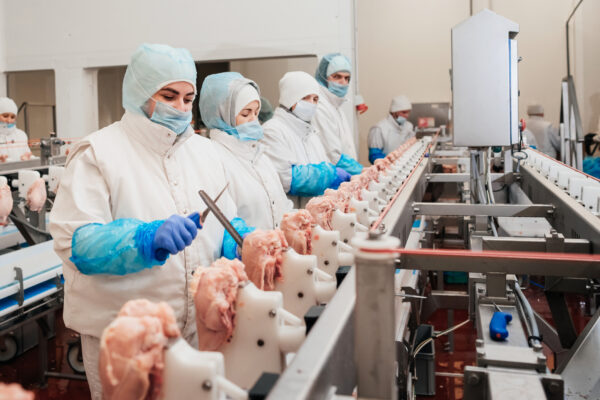
In a slaughterhouse, animals move down “the line” at a rapid rate to be slaughtered and processed. That rate is what is called the evisceration line speed. It is the speed at which machinery moves animals down the line to be processed, and it has a direct relationship with how quickly workers must make repetitive motions to process meat.
Another key measure of what workers experience on the line is the piece rate. The piece rate is the number of items handled by each individual worker per minute. The level of available workers will determine the piece rate: with the same number of workers, faster speeds mean each worker will have to do more.
On the recommendation of the Trump Administration, the FDA’s Food Service Inspection Service issued a new proposed rule on line speeds in February 2026. The regulation proposes increasing the maximum permitted line speed from 140 to 175 birds per minute in chicken slaughterhouses and from 55 to 60 birds per minute in turkey slaughterhouses. The proposal would also eliminate the maximum line-speed limit for swine slaughterhouses entirely.
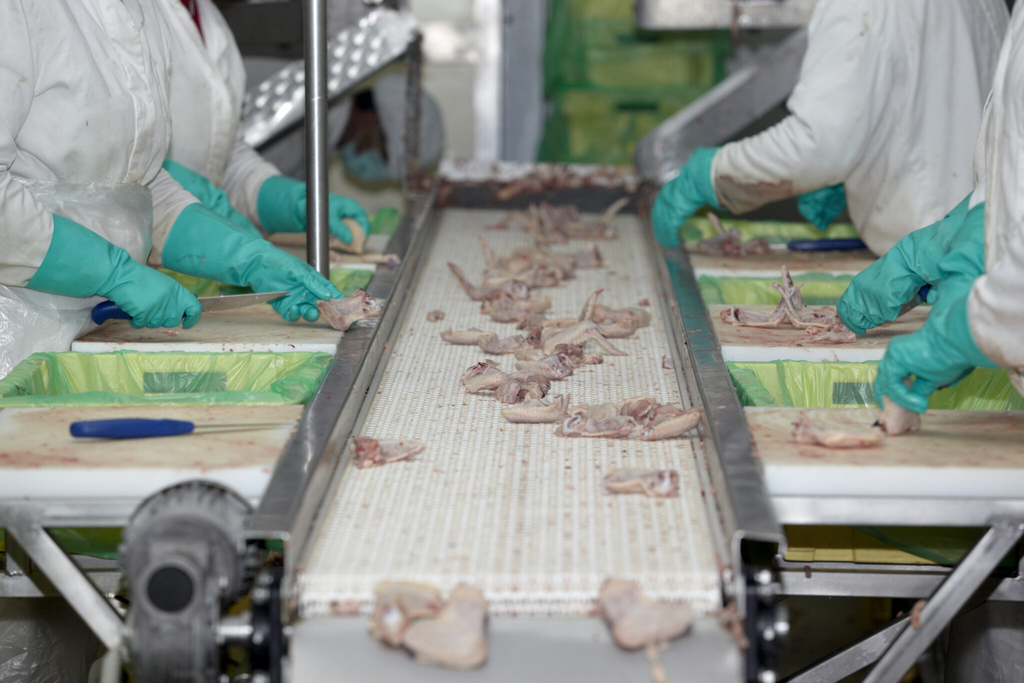
However, an increase in line speed will necessarily result in a higher piece rate if the number of workers remains unchanged—and the rule does not require maintaining any piece rate for safety. Obviously, ten workers who process 175 birds per minute will have to work much quicker than ten workers who process 140 birds per minute.
Four years ago, FSIS commissioned researchers Carisa Harris-Adamson and Robert Harrison to conduct a study. The PULSE study sought to evaluate the relationship between line speed and the risk of adverse health effects among workers in poultry and swine processing. The study specifically examined workers at poultry and swine processing establishments. The researchers found that a higher piece rate is significantly associated with an increased risk of severe work-related pain and musculoskeletal disorders.
At swine processing facilities in particular, workers are more vulnerable to developing disorders of the forearm, wrist, and hand, such as carpal tunnel syndrome, due to the nature of their tasks, which involve repeated, high-force movements at rapid speeds for extended periods. To protect workers from workplace injuries and illnesses, particularly the long-term health issues that may arise from this type of work, slaughterhouses should implement preventive measures—not make the work more dangerous by increasing line speed.
Despite the clear findings in the study that high piece rates endanger workers, FSIS held up the studies as justification for its dangerous new rules. FSIS didn’t just “misunderstand” the conclusions of the PULSE study – they fundamentally mischaracterized the study. The research does not support increasing line speed on either poultry or swine industrial farms. On the contrary, research consistently demonstrates that increasing line speed will significantly deteriorate workers’ health and safety.
The lack of concern for getting the science right about workers’ health from a public health agency demonstrates just how much power Big Ag has in this administration. When regulators put corporate profits before safety, workers suffer.
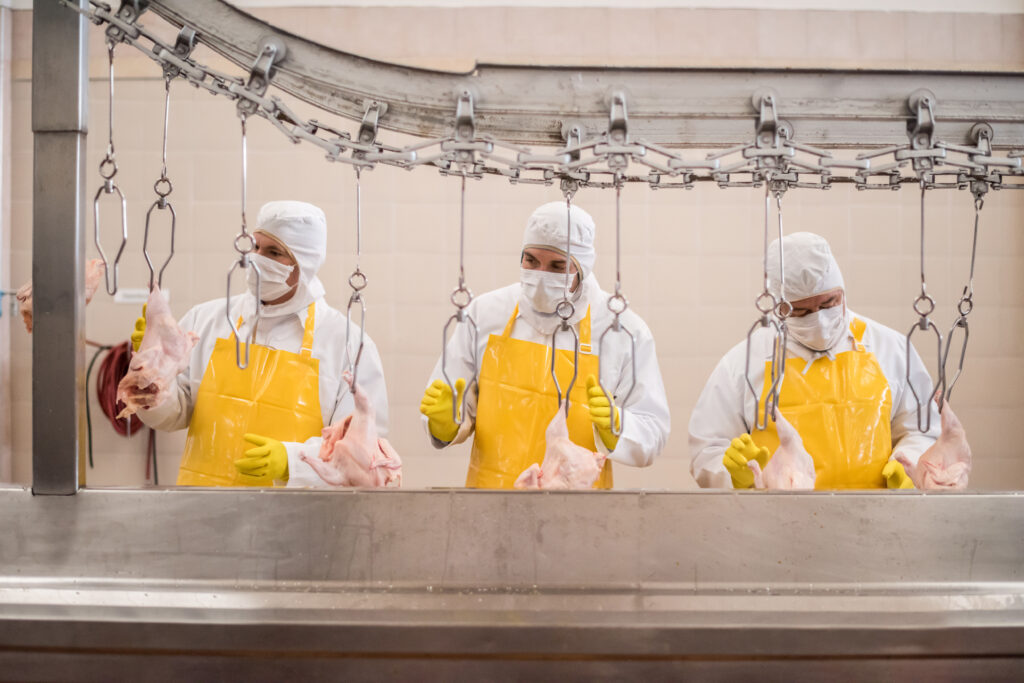
Increased injuries are not just hypothetical numbers in a report. For workers, a single injury can permanently change how they live the rest of their lives, leaving them with lifelong pain and disabilities. The cost of workplace injury rests mostly on the workers, as they are often unable to rejoin the workforce, while the slaughterhouse hires new replacement.
The consequences are real and undeniable. They are not temporary. They have ongoing measurable health costs for the workers.
FarmSTAND worked with the authors and primary researchers of the PULSE study, Carisa Harris-Adamson and Robert Harrison, to set the record straight. We submitted comments on the proposed rule, emphasizing what the study really says about worker safety.
The study strongly suggests that until these risks are mitigated, FSIS should not approve or facilitate increases in line speeds at poultry or swine slaughterhouses. Instead, it calls on poultry and swine slaughterhouses to implement the following regulations:
1. Reduce the work pace by decreasing the line speed, increasing the number of workers, or both.
2. Increase the number of workers.
3. Improve cutting safety by ensuring workers can easily access sharpened knives and rotate knives throughout the shift.
4. Allow for adequate rest times.
These are not novel recommendations. The Occupational Safety and Health Administration has consistently published guidance on these regulations since 1993. OSHA has suggested that slaughterhouses implement an ergonomics program, implement a medical surveillance program to better evaluate exposure prevention and management strategies, and maintain an accurate log of worker injuries and illnesses.
Despite the abundance of established solutions and preventive measures, poultry and swine slaughterhouses have largely failed to implement these recommendations. Why? Big agriculture does not care about the wellbeing of their workers — they care about profits. They make more money when they process more animals, and they don’t care what it costs workers. Without government accountability, these corporations will continue to act without consequences.
The FSIS claims that it does not have the authority to impose slower line speeds. The Proposed Rule even states that FSIS should not be held responsible for harm to workers. This is a cowardly dodge. FSIS must take accountability for its role in the continued suffering of workers rather than attempting to shift all responsibility and blame onto OSHA.
Meat processing workers deserve more than just voluntary guidelines. That is why FarmSTAND actively advocates for meatpacking workers through legal action and advocacy, seeking enforceable protections for their health and safety.
Through research, outreach, and regulatory comments, FarmSTAND aims to raise awareness of the harm faced by slaughterhouse workers and demand accountability from the government. By empowering both workers and the public with knowledge, FarmSTAND uses our legal expertise to bolster the movement for a food system that treats workers fairly.